In the demanding world of rubber compounding, the quest for the perfect balance between cost, weight, and mechanical performance is unending. While Carbon Black and Silica dominate the reinforcement market, Light Magnesium Carbonate (Light MgCO3) has carved out a vital niche as a high-performance “active” filler.
AMS Fine Chemicals, a premier manufacturer based in Bhavnagar, Gujarat, specializes in the production of ultra-pure Light Magnesium Carbonate designed specifically to enhance the physical properties of natural and synthetic rubber. This industrial guide details how Light MgCO3 improves tensile strength, tear resistance, and processing efficiency in the production of tires and industrial conveyor belts.
1. The Physics of Reinforcement: Why “Light” Matters
In rubber technology, a “filler” is only as good as its surface area. The “Light” in Light Magnesium Carbonate refers to its exceptionally low bulk density (~0.1 g/ml), which is a result of its unique porous, needle-like crystalline structure.
A. Surface Area Interaction
Unlike traditional Calcium Carbonate, which acts primarily as a space-filler (diluent), the particles of Light MgCO3 manufactured at our Bhavnagar facility provide a massive surface area for polymer chain interaction.
- Mechanical Interlocking: The jagged, microscopic morphology of Light MgCO3 creates a physical bond with the rubber matrix (Natural Rubber, SBR, or NBR).
- Cross-Linking Support: During vulcanization, these particles help distribute the sulfur cross-links more evenly, leading to a more robust molecular “web.”
2. Improving Tensile Strength in Tires and Belts
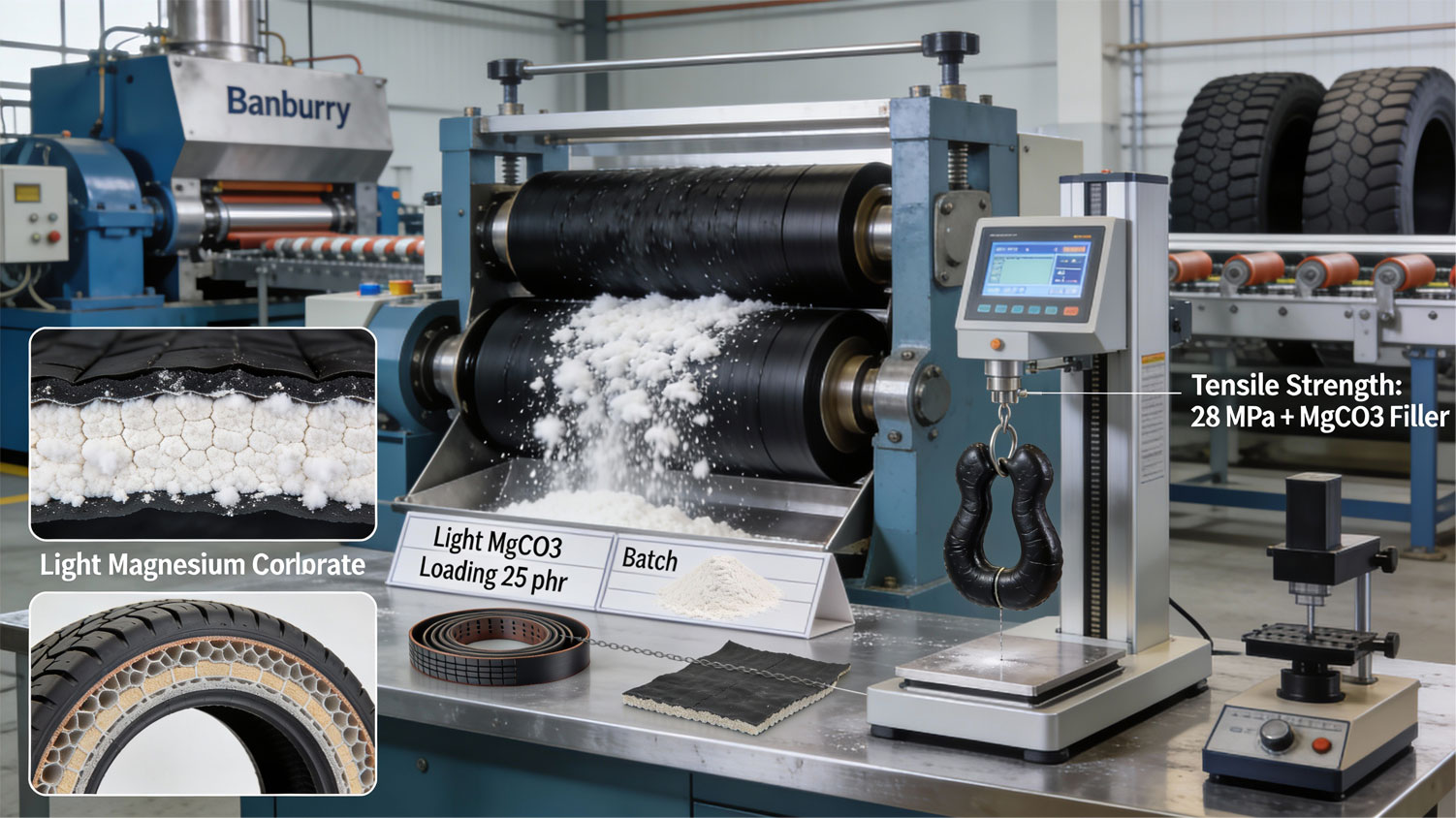
Tensile strength—the maximum stress a material can withstand while being stretched before breaking—is the most critical metric for tires and high-tension belts.
A. Application in Tire Sidewalls and Inner Liners
Tire sidewalls require high flexibility combined with the strength to resist punctures and abrasions.
- Crack Growth Resistance: Light MgCO3 particles act as “blunt objects” at the microscopic level. When a micro-crack begins to form in the rubber, it hits a magnesium carbonate particle and is forced to change direction or stop, preventing catastrophic failure.
- Heat Dissipation: Due to its specific heat capacity, Light MgCO3 helps manage the heat generated by the constant flexing of a tire, preserving the integrity of the rubber over long distances.
B. Conveyor Belts and Industrial Hoses
Conveyor belts used in mining and heavy industry are subject to immense “snatch” loads and constant abrasion.
- Tear Resistance: Formulations using Light MgCO3 exhibit significantly higher tear strength. This is essential for belts carrying sharp materials like crushed stone or scrap metal.
- Low Specific Gravity: Because Light MgCO3 is lighter than many mineral fillers, it reduces the overall weight of the belt, leading to lower energy consumption for the motors driving the conveyor systems.
3. Transparency and Aesthetic Versatility
A unique advantage of Light Magnesium Carbonate over Carbon Black is its refractive index.
- Translucent Rubber: For specialized applications like surgical tubing, translucent shoe soles, or colored industrial belts, Light MgCO3 provides reinforcement without turning the compound black.
- Color Brilliance: Because the material produced by AMS Fine Chemicals has a high whiteness index (>97%), it allows for vibrant color matching in consumer rubber products, which is impossible with traditional reinforcing agents.
4. Processing Benefits for Manufacturers
Beyond the final product’s strength, Light MgCO3 offers significant advantages during the actual manufacturing (mixing and milling) process.
A. Viscosity Regulation
During the compounding stage in a Banbury mixer, Light MgCO3 acts as a viscosity stabilizer. It prevents the compound from becoming too “soupy” at high temperatures, ensuring that the rubber can be extruded or molded into complex shapes with high precision.
B. Tackiness and Scorch Protection
- Tack Control: It helps manage the “tack” (stickiness) of uncured rubber sheets, making them easier to handle and stack in a factory setting.
- Scorch Safety: By acting as a mild heat buffer, it provides an extra margin of “scorch safety,” preventing the rubber from vulcanizing prematurely during the extrusion process.
5. Technical Specifications for the Rubber Industry
AMS Fine Chemicals maintains strict QC parameters to ensure our Light MgCO3 integrates seamlessly into high-speed production lines.
| Parameter | Rubber Grade Specification | Benefit to Compounder |
| Bulk Density (Untapped) | 0.08 – 0.12 g/ml | Maximizes reinforcement surface area. |
| Sieve Residue (325 Mesh) | < 0.1% | Prevents “nibs” or surface defects in thin rubber. |
| Moisture Content | < 2.0% | Prevents “blistering” during high-temp curing. |
| Whiteness Index | > 97% | Ensures color purity in non-black compounds. |
| Iron Content (Fe) | < 0.02% | Prevents oxidative aging of the rubber. |
6. Why AMS Fine Chemicals, Bhavnagar?
Bhavnagar, Gujarat, is a global hub for the salt and marine chemical industry. AMS Fine Chemicals leverages this strategic location to source the purest raw materials, which are then processed using state-of-the-art technology.
- Strategic Logistics: Proximity to major ports allows us to ship high-volume orders to tire manufacturers globally with minimal transit time.
- Customized Particle Sizes: We can adjust our precipitation process to provide specific surface areas required for different elastomers (EPDM, Neoprene, SBR).
- Environmental Compliance: Our manufacturing process focuses on sustainability, ensuring that our fillers are a “green” alternative to chemically intensive synthetic additives.
7. Conclusion
Light Magnesium Carbonate is a silent workhorse in the rubber industry. By providing a unique combination of tensile reinforcement, tear resistance, and aesthetic flexibility, it ensures that tires run longer and conveyor belts pull harder.
As a trusted partner to the rubber and polymer sectors, AMS Fine Chemicals continues to innovate, ensuring that the “Light” MgCO3 leaving our Bhavnagar facility meets the heavy-duty demands of global industry.