In the competitive landscape of the food processing industry, texture and flowability are as critical as flavor. Consumers expect their table salt to pour freely, their spices to sprinkle evenly, and their powdered beverages to dissolve without lumps. Achieving this consistency—especially in the humid climates of South Asia—requires a high-performance additive.
AMS Fine Chemicals, based in the industrial hub of Bhavnagar, Gujarat, is a premier manufacturer of Food-Grade Light Magnesium Carbonate (MgCO3). This industrial guide explores how this mineral functions as an essential anticaking agent, preserving the quality and shelf-life of powdered food products.
1. The Challenge: Why Food Powders Cake
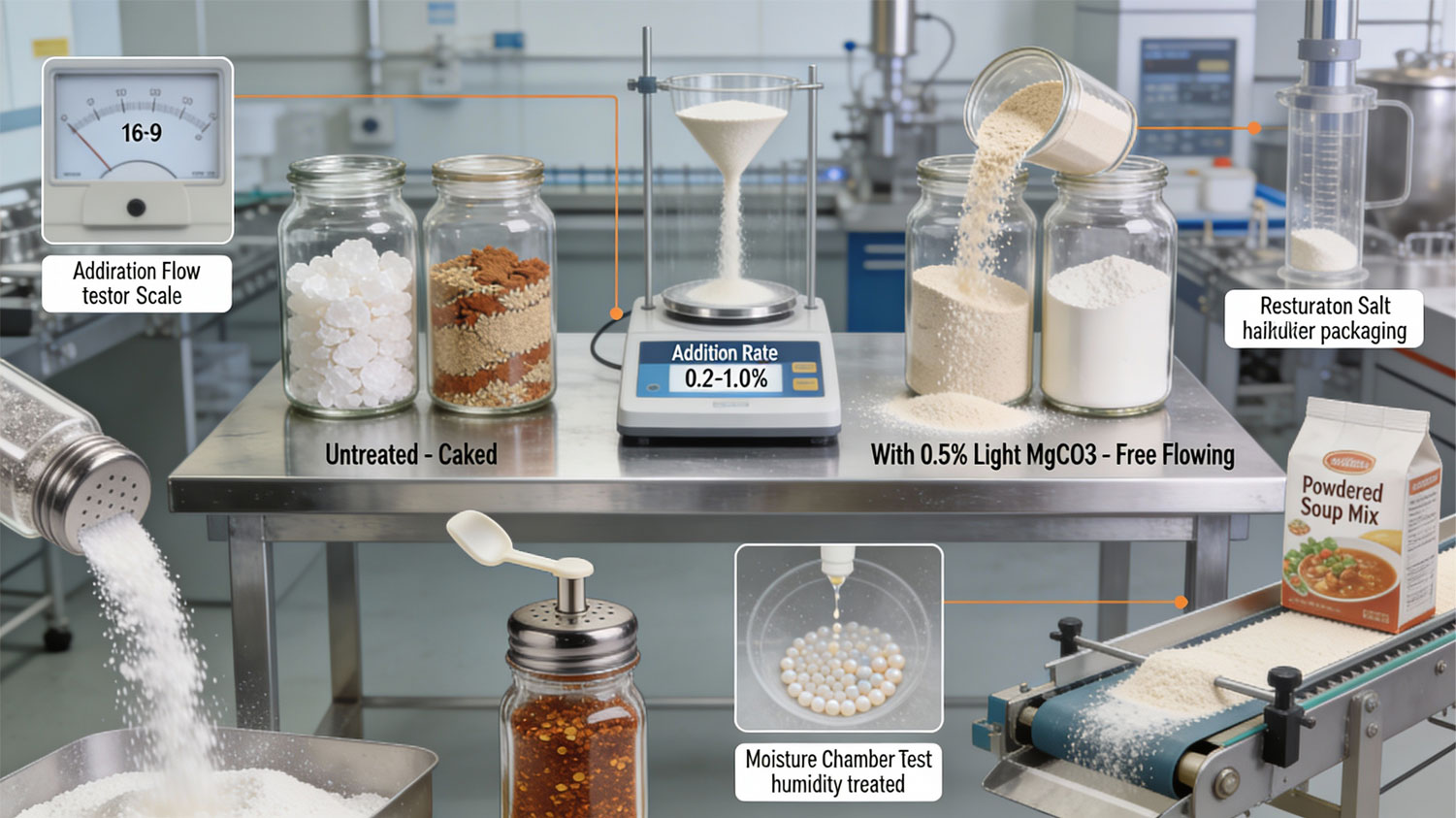
Caking is a common phenomenon where a free-flowing powder transforms into lumps or a solid mass. This occurs due to several factors:
- Hygroscopy: Many food ingredients, like sugar, salt, and onion powder, naturally attract moisture from the air.
- Liquid Bridges: When moisture is absorbed, it dissolves the surface of the particles, creating “sticky bridges” that fuse the particles together upon drying.
- Pressure and Temperature: Stacking bags of powder in a warehouse creates mechanical pressure, while temperature fluctuations accelerate chemical bonding between particles.
Light Magnesium Carbonate serves as the primary defense against these “liquid bridges,” maintaining the integrity of the product from the factory to the consumer’s kitchen.
2. Mechanism of Action: How Light MgCO3 Works
Light Magnesium Carbonate is uniquely suited for anticaking because of its physical morphology. Unlike “Heavy” grades, the Light grade features a porous, needle-like crystalline structure with an exceptionally high surface area.
A. The “Spacer” Effect
At a microscopic level, Light MgCO3 particles act as tiny ball bearings. They coat the larger food particles (like grains of salt), physically preventing them from touching each other. Because the particles cannot touch, they cannot fuse.
B. Moisture Scavenging (Absorption)
Because Light MgCO3 is highly porous, it acts as a molecular sponge. It can absorb a significant percentage of its own weight in water without becoming “wet” to the touch. By “locking away” ambient moisture within its own pores, it prevents that moisture from reaching the hygroscopic food particles.
C. Oil Absorption in Spices
Spices like paprika or chili powder contain natural oils that can make the powder greasy and prone to clumping. Light MgCO3 absorbs these excess oils, keeping the spice powder dry and free-flowing.
3. Applications in the Food Industry
A. Table Salt and Fortified Salts
Table salt is perhaps the most famous application for Light MgCO3. In a coastal country like India, high humidity can turn a bag of salt into a solid block within days.
- Usage: Adding 0.5% to 2.0% of Light MgCO3 ensures that salt remains “free-flowing” even in 90% humidity.
- White Color: Its high whiteness index ensures it blends invisibly with the salt crystals.
B. Powdered Spices and Seasoning Blends
Ground spices (Turmeric, Cumin, Chili) and complex seasoning mixes for snack foods rely on Light MgCO3 to prevent clumping during the high-speed automated packaging process.
- Flowability: It ensures that the powder “slides” through the packaging hoppers without sticking to the machinery.
C. Dehydrated Fruit and Vegetable Powders
Powders made from tomato, garlic, or onion are notoriously difficult to handle because of their high sugar and sulfur content. Light MgCO3 provides the necessary “dryness” to keep these powders usable for months.
D. Powdered Beverages and Vending Machine Mixes
Coffee creamers, instant tea, and cocoa powders used in vending machines must flow perfectly through narrow tubes. Any clumping results in machine failure. Light MgCO3 is the industry standard for ensuring these machines operate smoothly.
4. Technical Specifications for Food Grade (E504)
At AMS Fine Chemicals, our Food Grade Light Magnesium Carbonate is manufactured under strict hygienic conditions in Bhavnagar, meeting FSSAI and Food Chemicals Codex (FCC) standards.
| Specification | Standard Limit | Importance |
| Purity (as MgO) | 40.0% – 45.0% | Ensures high potency and mineral value. |
| Whiteness Index | > 97% | Prevents discoloration of the food product. |
| Bulk Density | 0.08 – 0.12 g/ml | Maximum volume for superior particle coating. |
| Lead (Pb) | < 2 ppm | Ensures safety and non-toxicity. |
| Arsenic (As) | < 1 ppm | Strict compliance with food safety laws. |
| Loss on Drying | < 2.0% | Ensures the additive is dry enough to absorb moisture. |
5. Regulatory Status and Safety
Magnesium Carbonate is recognized as a GRAS (Generally Recognized as Safe) substance by the US FDA and is categorized under E504 in the European Union.
- Non-Toxic: It is a natural mineral that does not affect the flavor or odor of the food.
- Nutritional Value: It adds elemental magnesium to the diet, which is an essential mineral for bone and heart health.
6. Why Source from AMS Fine Chemicals (Bhavnagar)?
Bhavnagar’s unique geographical location on the coast of Gujarat provides access to premium marine-sourced raw materials. AMS Fine Chemicals utilizes this advantage to produce a grade of Light MgCO3 that is:
- Ultra-Fine: Our air-jet milling process ensures a particle size so small it cannot be felt on the tongue, maintaining the “mouthfeel” of the food.
- Highly Absorbent: Optimized porosity for maximum moisture-holding capacity.
- Hygienically Packed: We use food-grade, moisture-proof liners to ensure that the “anticaking” power of the product is preserved until the moment you use it in your factory.
7. Conclusion: The “Invisible” Quality Essential
For food manufacturers, Light Magnesium Carbonate is an “invisible” insurance policy. It protects the brand’s reputation by ensuring that the product looks, feels, and pours exactly as the consumer expects every time.
Whether you are a salt refiner in Kutch or a spice exporter in Kerala, the quality of your anticaking agent dictates your product’s success on the shelf.