In an era of stringent fire safety regulations and environmental consciousness, the plastics industry is rapidly shifting away from halogenated flame retardants toward safer, mineral-based alternatives. AMS Fine Chemicals, a premier manufacturer based in Bhavnagar, Gujarat, is at the forefront of this transition, providing high-purity Light Magnesium Carbonate (Light MgCO3) for use in advanced polymer and PVC compounds.
This industrial guide explores the mechanisms, advantages, and applications of Light Magnesium Carbonate as a high-performance flame retardant and smoke suppressant.
1. The Science of Mineral-Based Flame Retardancy
Unlike traditional bromine or chlorine-based additives that release toxic gases during a fire, Light Magnesium Carbonate works through physical and endothermic mechanisms. It is classified as a non-halogenated flame retardant (NHFR), making it ideal for “Low Smoke Zero Halogen” (LSZH) applications.
A. The Endothermic Decomposition Mechanism
The primary function of Light MgCO3 in a fire is its ability to absorb heat. When the plastic compound reaches temperatures above 350°C, the magnesium carbonate undergoes a chemical breakdown:
MgCO3 + Heat > MgO + CO2
- Heat Absorption (The Heat Sink): This reaction is strongly endothermic. It “consumes” the heat energy that would otherwise fuel the thermal degradation of the plastic, effectively cooling the material.
- Oxygen Dilution: The release of Carbon Dioxide (CO2) gas creates a non-combustible “cloud” at the surface of the plastic. This dilutes the oxygen and flammable gases (pyrolyzates) in the flame zone, “starving” the fire.
- The Protective Char Layer: The resulting Magnesium Oxide (MgO) forms a solid, non-combustible ceramic layer (char) on the surface of the plastic. This layer acts as a thermal barrier, protecting the unburnt plastic beneath it from the heat.
2. Advantages of “Light” vs. “Heavy” Grade in Plastics
While both forms of magnesium carbonate provide fire protection, the Light Magnesium Carbonate manufactured at our Bhavnagar facility offers specific advantages for plastic compounding:
- Higher Surface Area: The “Light” grade has a porous, needle-like structure. This provides more surface area for the endothermic reaction to occur, resulting in faster cooling during a fire.
- Reduced Density: Light MgCO3 has a very low bulk density. In weight-sensitive applications like automotive or aerospace plastics, it provides flame retardancy without significantly increasing the weight of the final component.
- Transparency: Due to its refractive index, Light MgCO3 can be used in translucent or lightly colored plastic compounds where other minerals would make the plastic opaque.
3. Applications in PVC Compounds and Cables
The wire and cable industry is the largest consumer of flame-retardant PVC. In these applications, Light Magnesium Carbonate serves a dual purpose as both a functional filler and a safety additive.
A. Smoke Suppression in PVC
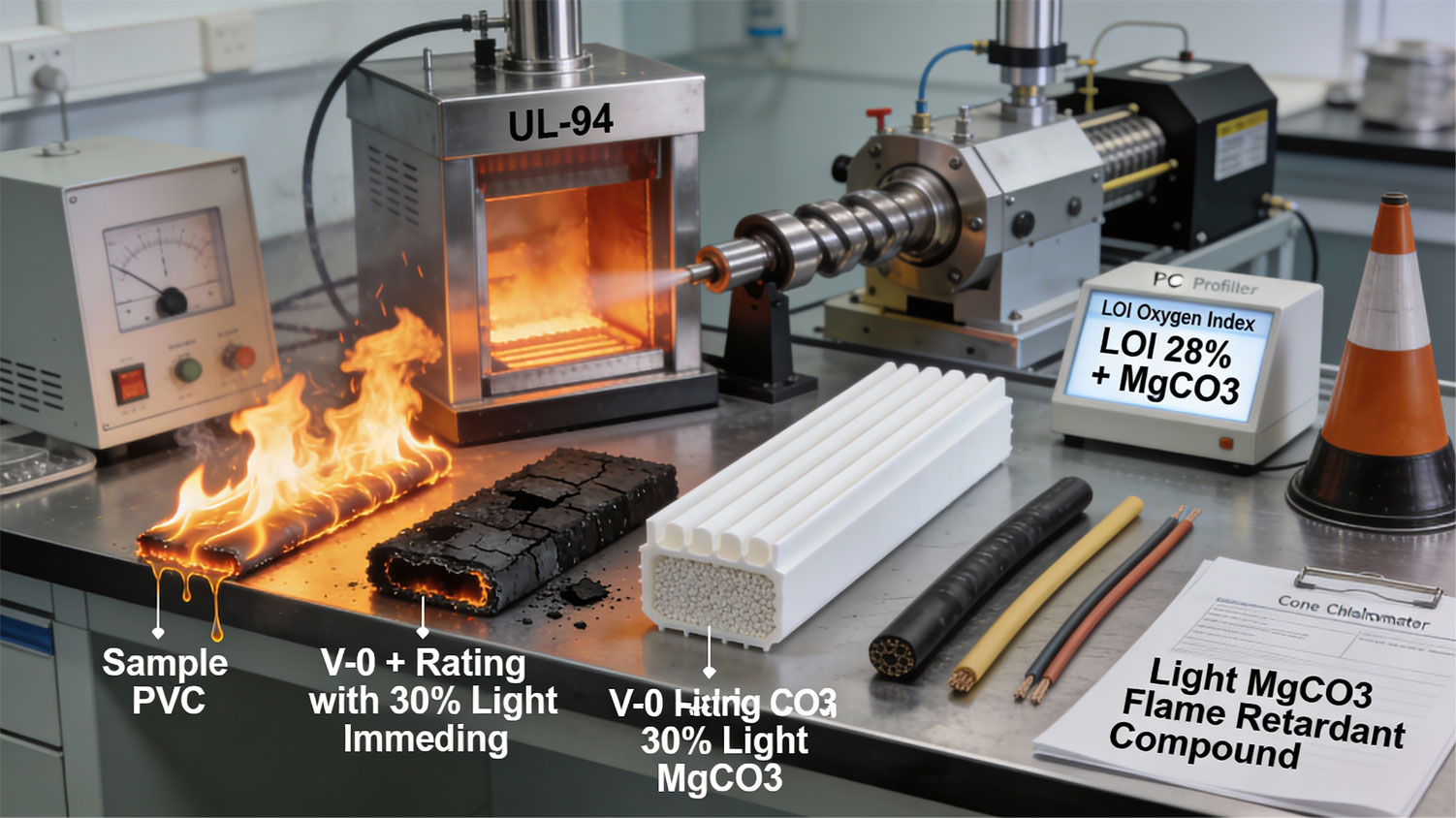
PVC inherently releases heavy smoke and toxic hydrochloric acid (HCl) gas when burned. Light MgCO3 acts as a smoke suppressant by facilitating the formation of a stable char. This prevents the “dripping” of molten plastic, which is a major cause of fire spread in building shafts and electrical panels.
B. Electrical Insulation Properties
Magnesium carbonate is an excellent electrical insulator. When used in PVC cable jackets, it does not interfere with the dielectric properties of the material, ensuring the cable remains safe for high-voltage applications.
C. Synergy with Alumina Trihydrate (ATH)
In many modern LSZH (Low Smoke Zero Halogen) formulations, Light MgCO3 is used in tandem with Alumina Trihydrate (Al(OH)3). This synergy allows for a broader range of protection, as ATH releases water vapor at lower temperatures, while MgCO3 releases CO2 at higher temperatures, providing multi-stage fire protection.
4. Performance in Thermoplastics (PP, PE, and Engineering Plastics)
Beyond PVC, Light Magnesium Carbonate is increasingly used in polyolefins (Polypropylene and Polyethylene).
- Polypropylene (PP): Used in electrical appliance housings and automotive interior parts. MgCO₃ increases the “Limiting Oxygen Index” (LOI), meaning a higher concentration of oxygen is required for the plastic to sustain a flame.
- Engineering Plastics: In high-heat environments like under-the-hood automotive components, MgCO3 helps maintain the dimensional stability of the plastic, preventing it from warping or melting under extreme thermal stress.
5. Technical Specifications for Plastic Grade MgCO3
At AMS Fine Chemicals, we maintain strict control over parameters that affect the “spinnability” and finish of plastic compounds.
| Parameter | Specification | Impact on Plastic Compound |
| Whiteness Index | > 97% | Ensures no color shift in vibrant plastic parts. |
| Moisture Content | < 1.0% | Prevents “voids” or bubbles during extrusion/molding. |
| Average Particle Size | 2 – 5 Microns | Ensures smooth surface finish and high impact strength. |
| Oil Absorption | 100 – 150 ml/100g | Dictates the amount of plasticizer required in the mix. |
| Acid Insoluble | < 0.1% | Prevents damage to expensive extrusion dies and molds. |
6. Manufacturing Excellence in Bhavnagar, Gujarat
Sourcing flame retardants from AMS Fine Chemicals provides a strategic advantage to plastic manufacturers in India and abroad.
- Chemical Consistency: Our facility in Bhavnagar utilizes advanced precipitation technology to ensure every batch has the same decomposition profile, which is critical for meeting UL-94 fire safety ratings.
- Surface Treatment: We offer surface-treated (stearic acid coated) Magnesium Carbonate. This treatment makes the mineral “hydrophobic,” allowing it to disperse more easily into non-polar plastics like Polyethylene, resulting in better mechanical strength.
- Scalability: Our production capacity allows us to support large-scale industrial projects, from city-wide infrastructure cabling to automotive manufacturing lines.
7. Conclusion: The Future of Fire Safety
As global standards move toward “Green Chemistry,” Light Magnesium Carbonate stands out as a non-toxic, eco-friendly solution to a life-safety problem. It provides plastic manufacturers with a cost-effective way to achieve high fire ratings without the environmental baggage of halogenated chemicals.
AMS Fine Chemicals remains committed to being Gujarat’s leading partner in polymer innovation, ensuring that the plastics of tomorrow are stronger, lighter, and—above all—safer.