In the modern industrial era, the management of liquid waste is no longer just a regulatory hurdle—it is a cornerstone of corporate social responsibility and operational sustainability. As industrial hubs across India, particularly in Gujarat, face stricter environmental norms, the choice of neutralization agents has shifted from harsh, traditional chemicals to safer, more efficient minerals.
AMS Fine Chemicals, based in Bhavnagar, Gujarat, is a premier manufacturer of high-purity Magnesium Hydroxide [Mg(OH)₂]. This technical guide explores why Magnesium Hydroxide has become the “Gold Standard” for industrial wastewater treatment, specifically focusing on its dual role in pH neutralization and the precipitation of heavy metals.
1. Introduction: The Chemistry of a Smarter Alkali
Magnesium Hydroxide is an inorganic compound that serves as a non-hazardous, weakly alkaline base. In wastewater treatment, it is often utilized as a stabilized slurry (often called “Milk of Magnesia”) or a high-purity powder.
Unlike its counterparts—Sodium Hydroxide (Caustic Soda) and Calcium Hydroxide (Lime)—Magnesium Hydroxide offers a unique “controlled release” of alkalinity. This characteristic is the foundation of its superior performance in complex industrial effluents.
Physical and Chemical Profile
- Chemical Formula: Mg(OH)₂
- Physical State: White, odorless powder or liquid slurry.
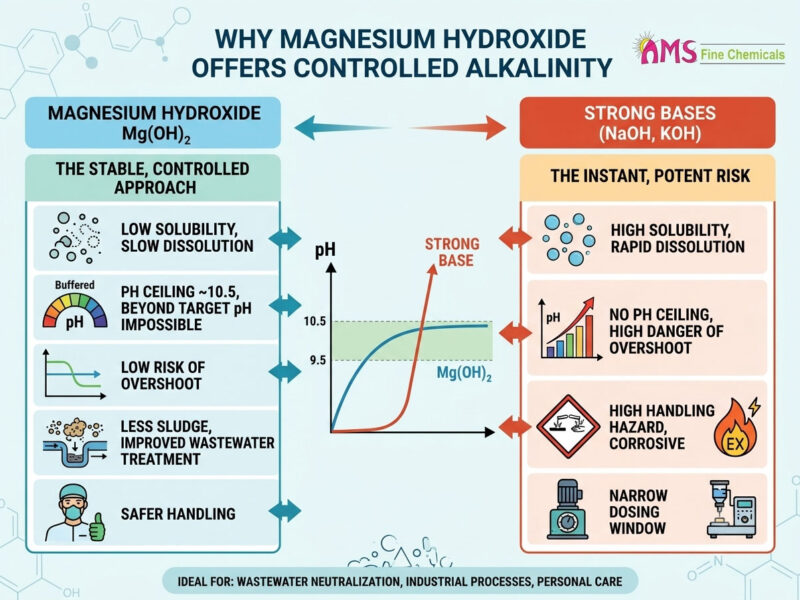
- Solubility: Low solubility in water, which allows for a self-buffering effect.
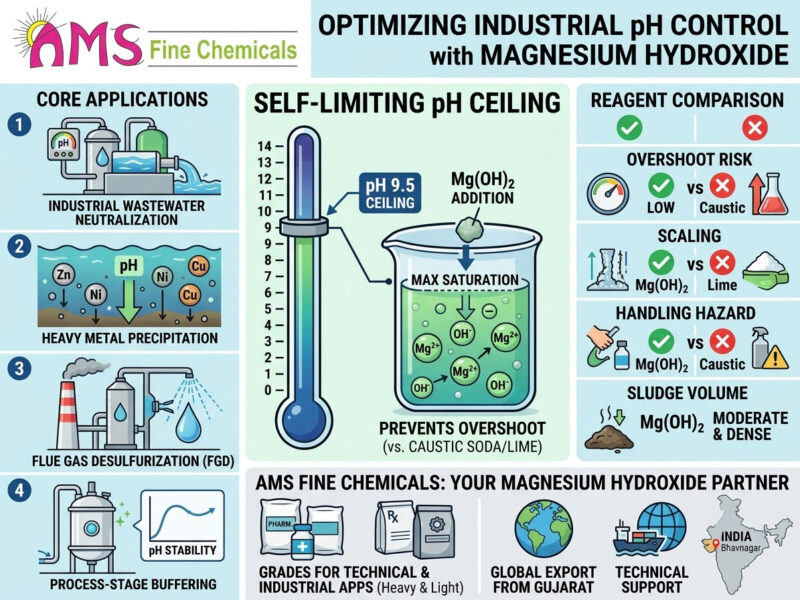
- pH Capability: Provides a maximum pH of approximately 9.0 to 9.5.
2. pH Neutralization: The “Self-Buffering” Advantage
The most significant challenge in wastewater treatment is “pH overshooting.” Traditional strong bases like Caustic Soda (NaOH) can send the pH of a waste stream from 2.0 to 12.0 with a single accidental over-dose.
A. The Risk of Strong Bases
When the pH exceeds 10.0, the biological treatment systems (aerobic and anaerobic bacteria) in many Wastewater Treatment Plants (WWTP) are compromised or killed. This results in costly downtime and regulatory fines.
B. The Magnesium Hydroxide Buffer
Because Mg(OH)₂ is only slightly soluble, it only dissolves as it reacts with the acid in the water.
- Automatic Control: As the acid is neutralized, the pH rises.
- Safety Stop: Once the pH reaches roughly 9.0, the Magnesium Hydroxide stops dissolving.
- Result: It is virtually impossible to “overshoot” the pH into a dangerous alkaline range. This “built-in” safety mechanism reduces the need for expensive, high-precision dosing equipment.
3. Heavy Metal Precipitation
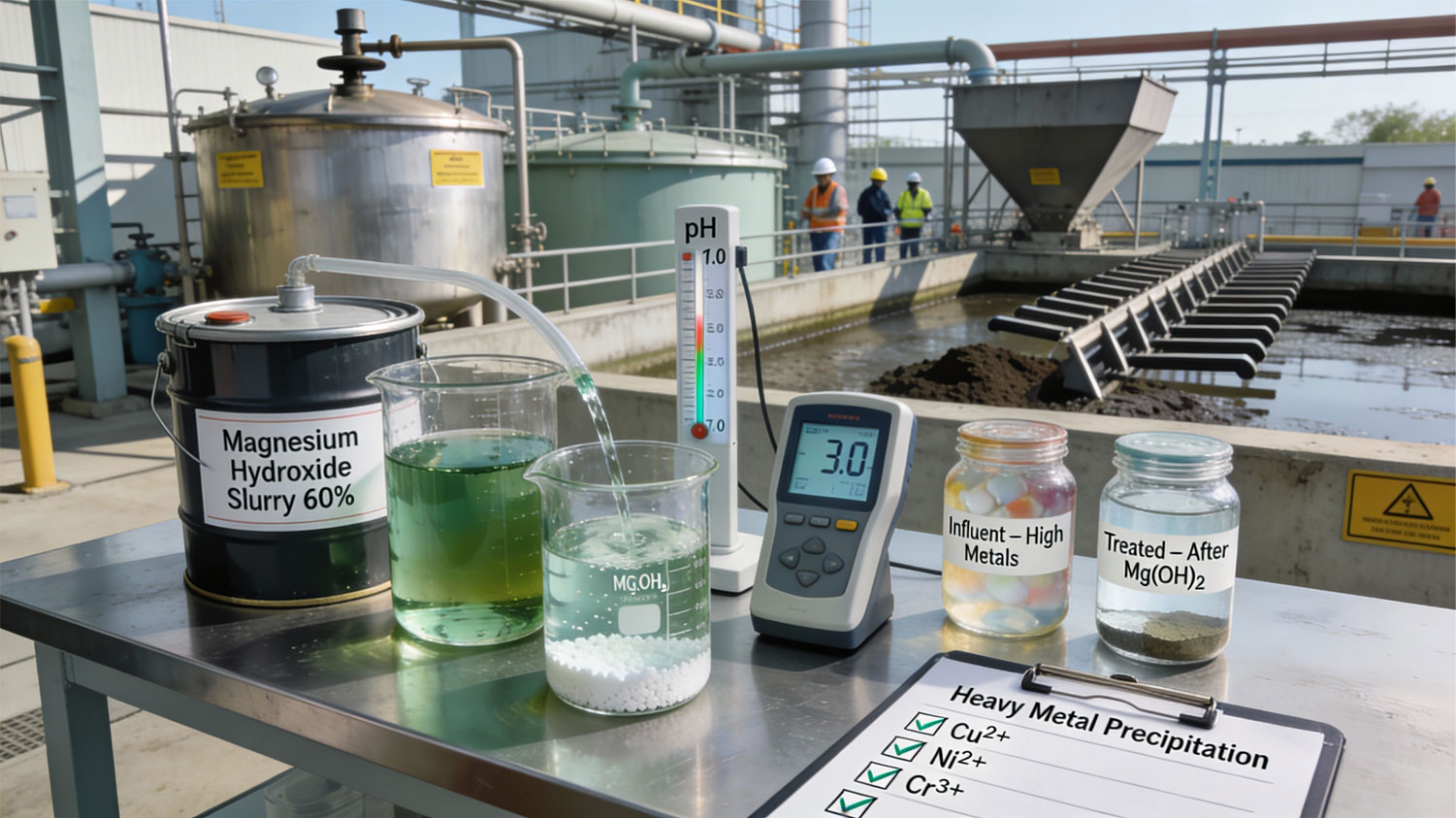
Industries such as electroplating, mining, and chemical manufacturing often produce waste streams contaminated with toxic heavy metals like Copper (Cu), Nickel (Ni), Zinc (Zn), Lead (Pb), and Chrome (Cr).
A. The Solubility Minimum
The removal of these metals is usually achieved by raising the pH to a point where the metals become insoluble and precipitate out as solids. Every metal has a “solubility minimum”—a specific pH where it is easiest to remove.
B. Why Mg(OH)₂ is Superior for Metal Removal
- Lower Sludge Volume: Magnesium Hydroxide produces a much denser, more crystalline precipitate compared to Lime or Caustic Soda. This “heavy” sludge settles faster.
- Filtration Efficiency: Because the particles are larger and more granular, the resulting sludge is easier to dewater using filter presses, leading to significant savings in disposal costs.
- Multi-Metal Treatment: Because Mg(OH)₂ buffers the pH in the 8.5–9.5 range, it perfectly aligns with the solubility minimum of most common industrial heavy metals, allowing for “one-step” removal of multiple contaminants.
4. Operational Benefits Over Caustic Soda and Lime
For the plant managers of Gujarat and beyond, the switch to Magnesium Hydroxide offers three primary operational wins:
1. Safety and Corrosivity
- Caustic Soda: Highly corrosive. Requires specialized storage, protective gear, and poses severe chemical burn risks to operators.
- Mg(OH)₂: Non-corrosive and non-toxic. It can be handled safely without the risk of skin burns, and it is not harmful if accidentally spilled.
2. Sludge Handling and Disposal
- Lime (Calcium Hydroxide): Produces a massive volume of “fluffy” sludge that is difficult to dry.
- Mg(OH)₂: Creates a compact, high-density sludge. It typically reduces total sludge volume by 20% to 40% compared to Lime, drastically lowering “gate fees” at hazardous waste landfills.
3. Nutrient for Biological Systems
Magnesium is a vital nutrient for the microbes used in secondary wastewater treatment. Using Mg(OH)₂ provides a slow-release source of magnesium, which can actually improve the health and efficiency of the bacteria in the aeration tanks.
5. Technical Specifications from AMS Fine Chemicals
At AMS Fine Chemicals, we produce Magnesium Hydroxide tailored for the rigors of industrial waste treatment.
| Specification | Wastewater Grade (Powder) | Slurry Grade (Liquid) |
| Purity [Mg(OH)₂] | > 98.5% | 50% – 60% Solids |
| Average Particle Size | 3.0 – 6.0 microns | Stabilized Suspension |
| Reactivity (Citric Acid) | High | Optimized for Fast Mixing |
| Heavy Metals (Pb/As) | < 10 ppm | < 5 ppm |
6. Applications by Industry Sector
A. Textile and Dyeing (Surat & Ahmedabad Hubs)
The textile industry produces highly acidic, color-heavy effluent. Mg(OH)₂ effectively neutralizes the acidity and helps in the flocculation of dyes, making the water clearer for subsequent treatment.
B. Electroplating and Metal Finishing
Used to remove Chromium and Nickel. The crystalline sludge produced by Mg(OH)₂ makes the recovery or disposal of these metals much more efficient.
C. Acid Mine Drainage (AMD)
Used in the mining sector to treat large volumes of acidic water, preventing toxic runoff from entering local groundwater supplies.
7. Conclusion: The Sustainable Choice for Gujarat’s Industry
As environmental regulations grow more stringent, the transition to Magnesium Hydroxide represents a move toward “Green Chemistry.” It is safer for the operator, kinder to the equipment, and more efficient for the environment.
AMS Fine Chemicals (Bhavnagar) is committed to supporting Indian industries with high-quality, locally manufactured magnesium solutions. By choosing Mg(OH)₂, you are not just treating water; you are optimizing your entire waste management lifecycle.