In the specialized world of chemical manufacturing, precision in physical properties is often as critical as chemical purity. At AMS Fine Chemicals, based in Bhavnagar, Gujarat, we produce high-performance Magnesium Carbonate for global markets. One of the most frequent points of discussion with our industrial partners is the choice between the two primary physical forms of the compound: Light and Heavy.
This guide provides a technical exploration of Heavy Magnesium Carbonate, focusing on its density, unique particle structure, and the functional differences that distinguish it from its “Light” counterpart.
1. Defining Heavy Magnesium Carbonate
Heavy Magnesium Carbonate (MgCO3) is a dense, white, granular powder. While it shares the same basic chemical identity as the Light grade, it is synthesized through a specific precipitation and drying process that yields a more compact crystalline arrangement.
In industrial terms, “Heavy” does not refer to the weight of the atoms, but to the Bulk Density—the mass of the powder that fits into a specific volume.
Key Physical Characteristics:
- Appearance: A granular, relatively free-flowing white powder.
- Feel: Unlike the “fluffy” or “air-like” feel of the Light grade, Heavy MgCO3 feels substantial and gritty between the fingers.
- Solubility: Practically insoluble in water, but dissolves with effervescence in dilute acids.
2. The Science of Density: Bulk vs. Tapped
The most defining metric for Heavy Magnesium Carbonate produced at our Bhavnagar facility is its density. In the pharmaceutical and food industries, we measure this in two ways:
A. Bulk Density (Untapped)
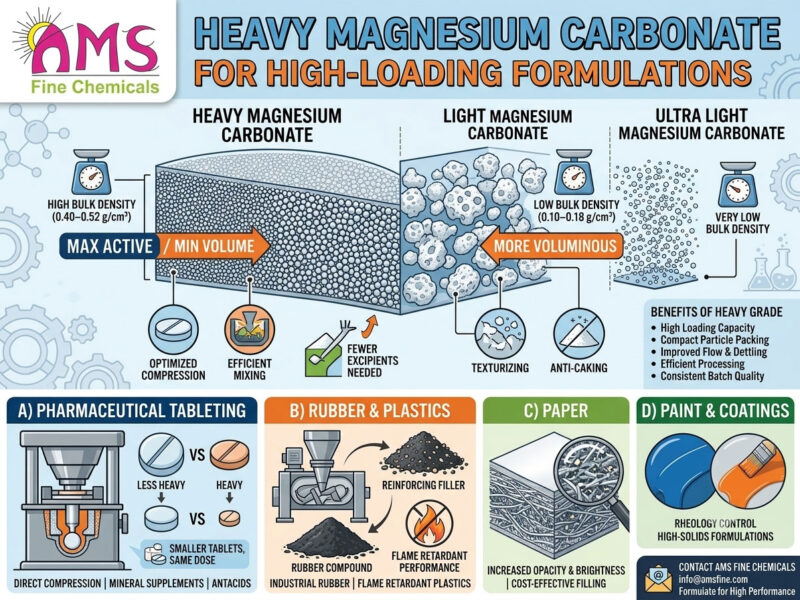
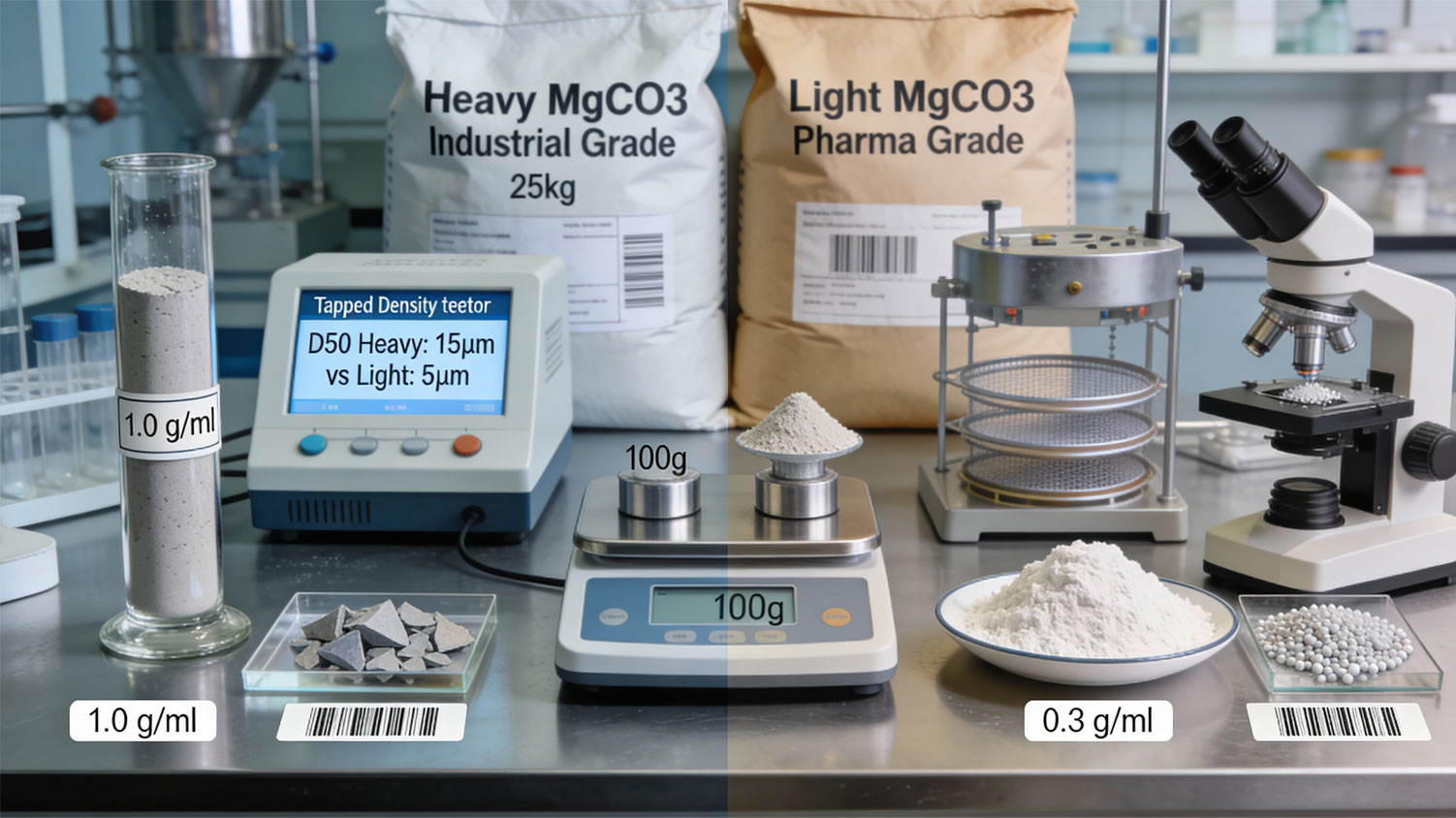
This is the density of the powder as it is poured into a container. For Heavy Magnesium Carbonate, the bulk density typically ranges from 0.45 g/ml to 0.55 g/ml.
Comparison: Light Magnesium Carbonate has a bulk density of roughly 0.06 to 0.15 g/ml. This means the Heavy grade is nearly 5 times denser than the Light grade.
B. Tapped Density
This is the density achieved after a container is mechanically tapped to settle the particles. Heavy MgCO3 has a very low “compressibility index,” meaning it doesn’t settle much further because its particles are already naturally compact.
3. Particle Structure and Morphology
The difference in density is a direct result of the Particle Structure. Using scanning electron microscopy, we can observe that the Heavy grade lacks the needle-like, porous structure of the Light grade.
Compact Crystalline Form
The particles of Heavy Magnesium Carbonate are generally more spherical and have a much lower internal porosity.
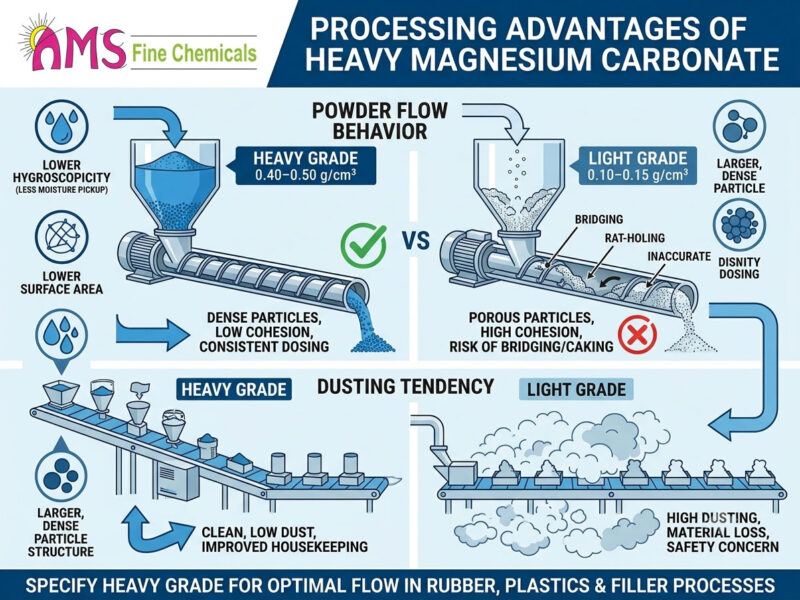
- Surface Area: Because the particles are compact and “filled in,” the total surface area per gram is significantly lower than that of the Light grade.
- Flow Properties: The spherical and granular nature of the particles reduces friction between them. This makes Heavy MgCO3 exceptionally “free-flowing,” allowing it to move easily through industrial hoppers and tablet presses without clogging.
4. Heavy vs. Light: Key Differences at a Glance
For procurement and R&D teams, choosing the correct grade is vital for manufacturing efficiency.
| Feature | Heavy Magnesium Carbonate | Light Magnesium Carbonate |
| Bulk Density | High (~0.5 g/ml) | Low (~0.1 g/ml) |
| Particle Form | Compact, Granular | Porous, Needle-like |
| Flowability | Excellent | Poor (Clumpy) |
| Moisture Absorption | Low | Very High |
| Primary Use | Tablets & Granulation | Sports Chalk & Suspensions |
| Space Required | Low (Compact storage) | High (Bulky storage) |
5. Major Industrial Applications
A. Pharmaceutical Tableting (Direct Compression)
This is the primary home of Heavy Magnesium Carbonate. In modern drug manufacturing, speed and uniformity are essential.
- Die Filling: Because it flows so well, it fills the tablet press dies evenly, ensuring every tablet has the exact same weight and dose.
- Compressibility: It acts as an excellent filler and binder, creating hard tablets that don’t crumble during shipping.
B. Glass and Ceramics
In the glass industry, Heavy MgCO3 is used as a source of Magnesium Oxide.
- Dust Control: Because it is dense, it doesn’t blow away in the high-velocity air systems of industrial kilns, leading to less waste and a cleaner environment.
C. Mineral Fortification (Nutraceuticals)
When manufacturers want to create a high-potency Magnesium supplement in a small capsule, they use the Heavy grade. Its density allows more “Magnesium per Millimeter,” making the capsule easier for the consumer to swallow.
6. Manufacturing Excellence in Bhavnagar
AMS Fine Chemicals utilizes the unique geographic and industrial advantages of Bhavnagar, Gujarat, to produce a Heavy grade that meets the highest global standards (IP, BP, USP).
- Advanced Precipitation: We control the temperature and agitation speed in our reactors to ensure the crystals grow to the exact density required by our clients.
- Sieve Analysis: Every batch is sieved to ensure a uniform particle size distribution, preventing “grittiness” and ensuring smooth processing in your factory.
7. Conclusion: Choosing the Right Density
Heavy Magnesium Carbonate is the “efficiency expert” of the mineral world. While the Light grade is prized for its absorption, the Heavy grade is prized for its predictability, flow, and compactness.11
Whether you are formulating a life-saving tablet or manufacturing high-clarity glass, the density of your MgCO3 will dictate your success. AMS Fine Chemicals is committed to providing the technical consistency that allows your production lines to run at peak performance.