In the high-performance world of polymer engineering, the demand for additives that provide both structural reinforcement and safety features is at an all-time high. AMS Fine Chemicals, a leading manufacturer based in Bhavnagar, Gujarat, specializes in high-purity Magnesium Carbonate (MgCO3) tailored specifically for the rubber and plastics industries.
This comprehensive industrial guide explores the dual-action role of Magnesium Carbonate as a high-efficiency filler and a non-halogenated flame retardant, providing technical insights for compounders and material scientists.
1. The Evolution of Fillers in Polymer Science
Historically, fillers were used simply to “extend” a compound and reduce costs. However, modern manufacturing requires “active” fillers that contribute to the mechanical properties of the final product.
Magnesium Carbonate is a white, inorganic mineral that offers a unique combination of low density, high whiteness, and thermal instability—the very property that makes it an excellent flame retardant.
Key Physical Properties for Industrial Use:
- High Whiteness/Reflectance: Essential for color-sensitive plastic and rubber products.
- Low Specific Gravity: Compared to other mineral fillers like Calcium Carbonate, MgCO3 helps in producing lighter-weight components.
- Particle Morphology: AMS Fine Chemicals produces a “Light” grade with an extremely high surface area, which facilitates better bonding with polymer chains.
2. Magnesium Carbonate as a Reinforcing Filler in Rubber
In rubber compounding, Magnesium Carbonate is categorized as a “semi-reinforcing” filler. It sits in the vital space between low-cost diluents and high-cost carbon blacks.
A. Transparency and Translucency
One of the greatest advantages of using MgCO3 over Carbon Black is transparency. For products like translucent shoe soles, surgical gloves, and clear tubing, Magnesium Carbonate provides the necessary stiffness without turning the compound opaque.
B. Tensile Strength and Tear Resistance
Because of the fine particle size (especially in the “Light” grade), the mineral distributes evenly within the elastomer matrix. This reduces the concentration of stress points, leading to:
- Increased Modulus of Elasticity.
- Improved Tear Strength in natural and synthetic rubbers (SBR, NBR, EPDM).
- Better Abrasion Resistance for conveyor belts and flooring.
C. Processing Benefits
Unlike some abrasive fillers, Magnesium Carbonate acts as a mild processing aid. It reduces the viscosity of the rubber mix during milling, leading to lower energy consumption and less wear on the machinery.
3. The Mechanism of Flame Retardancy
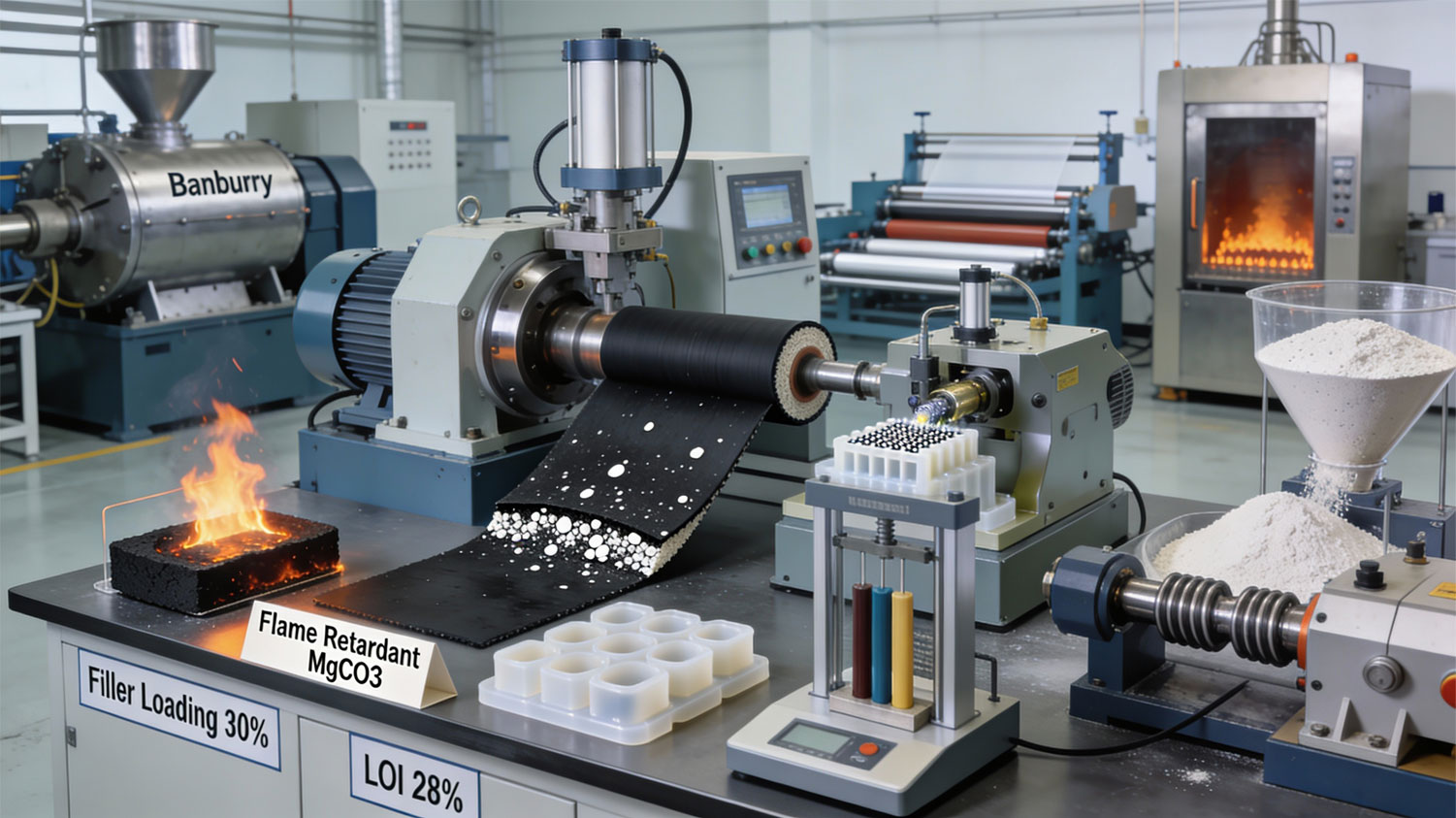
Safety regulations in the automotive, construction, and aerospace industries demand materials that are self-extinguishing and low-smoke. Magnesium Carbonate is a premier Non-Halogenated Flame Retardant (NHFR).
A. Endothermic Decomposition
The magic of MgCO3 lies in its thermal behavior. When exposed to heat (above 350°C), it undergoes an endothermic decomposition (it absorbs heat from the fire):
MgCO3 + Heat → MgO + CO2
- Heat Sink: The reaction “sucks” thermal energy away from the polymer, cooling the material.
- Gas Dilution: The released Carbon Dioxide (CO2) dilutes the oxygen and flammable gases at the surface of the plastic, “starving” the flame.
- Char Formation: The resulting Magnesium Oxide (MgO) forms a solid, non-combustible “char” layer on the surface, which acts as a thermal barrier against further burning.
B. Smoke Suppression
Unlike halogenated flame retardants (which release toxic, black smoke), Magnesium Carbonate is a smoke suppressant. It reduces the amount of soot produced during combustion, which is critical for materials used in underground subways, high-rise buildings, and electrical enclosures.
4. Applications in the Plastics Industry
In plastics, Magnesium Carbonate is often used in Thermoplastics and Thermosets to improve both aesthetic and safety profiles.
- PVC Compounds: Used in cable insulation to provide flame retardancy and improve the electrical insulation properties.
- Polypropylene (PP) and Polyethylene (PE): Acts as a stiffening agent and helps maintain dimensional stability under heat.
- Polyester Resins: Used in Bulk Molding Compounds (BMC) and Sheet Molding Compounds (SMC) for electrical housings.
5. Technical Comparison: MgCO3 vs. Other Fillers
| Property | Magnesium Carbonate | Calcium Carbonate | Magnesium Hydroxide (MDH) |
| Reinforcement | Moderate to High | Low | Moderate |
| Flame Retardancy | Yes (Active) | No (Inert) | Yes (High) |
| Smoke Suppression | Excellent | Poor | Excellent |
| Weight | Light | Heavy | Moderate |
| Transparency | High | Low/Opaque | Moderate |
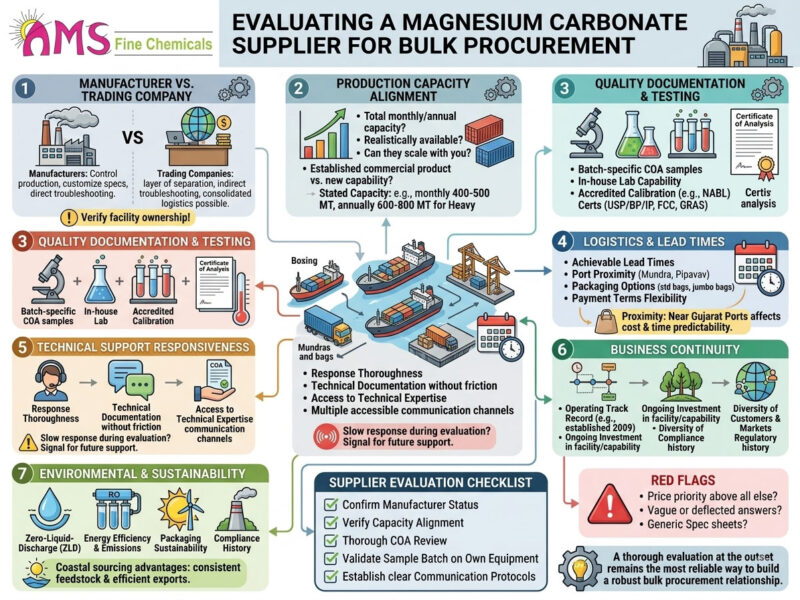
6. Sourcing from AMS Fine Chemicals (Bhavnagar, Gujarat)
The performance of MgCO3 in rubber and plastic depends entirely on its purity and particle size distribution.
AMS Fine Chemicals utilizes the unique mineral resources of the Gujarat coastline to produce industrial-grade Magnesium Carbonate that features:
- Low Moisture Content: Essential to prevent “blistering” during high-temperature plastic extrusion.
- Consistent Bulk Density: Ensures that automatic dosing systems in factories remain accurate.
- Low Impurities: Minimal iron and heavy metal content ensures the aging properties of the rubber are not compromised.
7. Conclusion: A Sustainable Choice
As global industries move away from toxic halogenated chemicals, Magnesium Carbonate stands out as an eco-friendly, “green” additive. It provides a dual-purpose solution—strengthening the material while protecting lives through advanced fire safety.
By choosing AMS Fine Chemicals, manufacturers gain a partner committed to the precision and quality required for the next generation of polymer compounds.