In the competitive landscape of pharmaceutical manufacturing, the choice of excipients is as critical as the selection of the active pharmaceutical ingredient (API) itself. Magnesium Carbonate (MgCO3), particularly the high-purity grades manufactured by AMS Fine Chemicals in Bhavnagar, Gujarat, has emerged as a multifunctional powerhouse.
This guide explores the sophisticated technical roles of magnesium carbonate in tablet formulation—moving beyond its traditional use as an antacid to its vital functions as a filler, binder, and pH controller.
1. Introduction to Magnesium Carbonate in Tableting
Modern tablet formulation is a balance of physics and chemistry. A tablet must be hard enough to withstand shipping but porous enough to dissolve in the stomach. AMS Fine Chemicals specializes in producing Magnesium Carbonate that bridges this gap, offering a versatile profile that simplifies the manufacturing process.
Whether using Light Magnesium Carbonate for its high surface area or Heavy Magnesium Carbonate for its superior flow, this compound provides structural integrity and chemical stability to solid dosage forms.
2. Magnesium Carbonate as a Filler (Diluent)
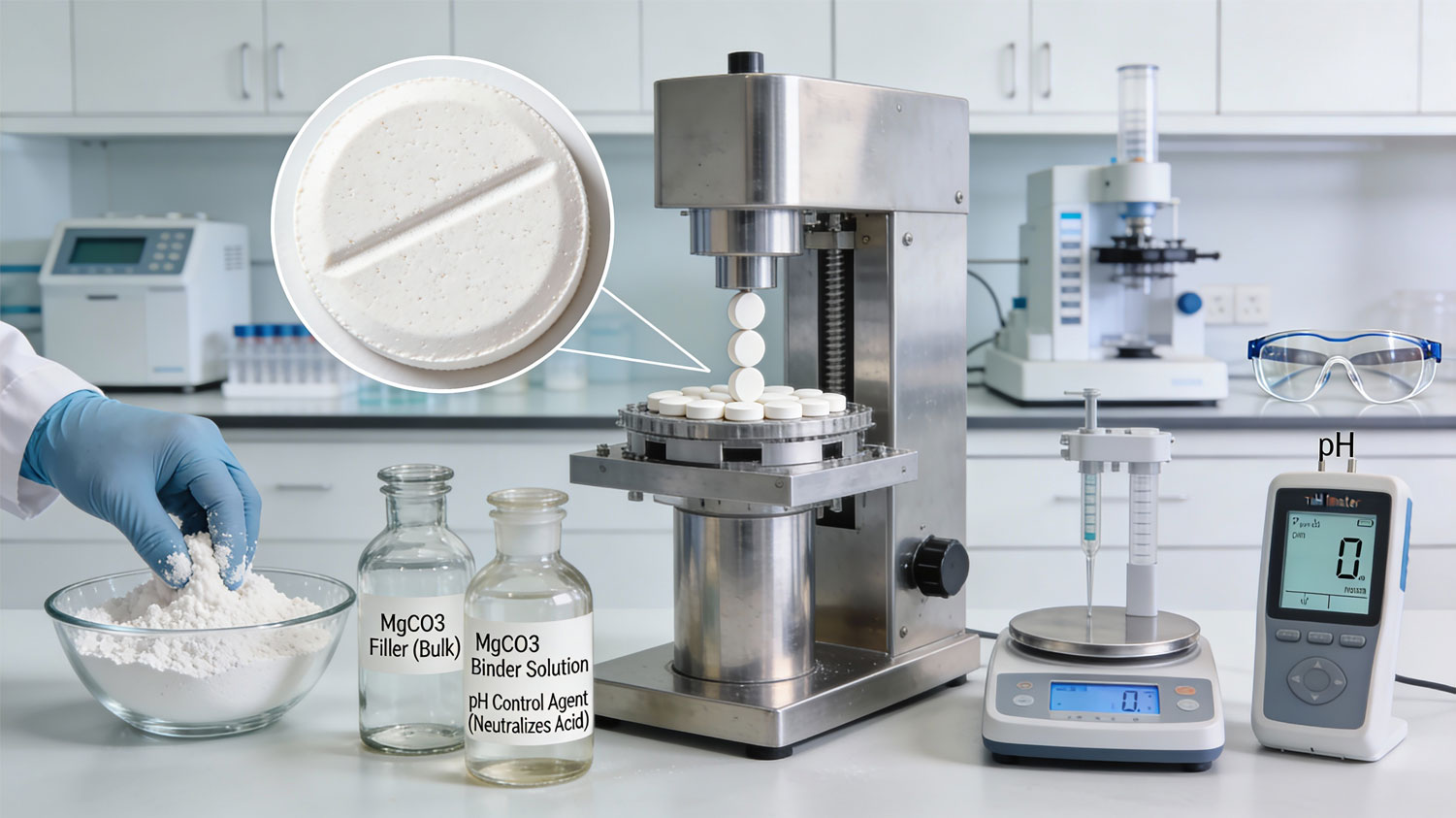
The primary role of a filler is to add “bulk” to a tablet, especially when the active drug dose is very small (e.g., 5mg or 10mg). However, Magnesium Carbonate is much more than just a “space-filler.”
A. Enhancing Physical Bulk
Magnesium Carbonate is chemically inert, meaning it does not react with the majority of APIs.3 This makes it a safe “diluent” for a wide range of medications.
- Heavy Grade Efficiency: Heavy MgCO3 has a high bulk density (~0.5 g/ml), allowing manufacturers to create smaller, more “swallowable” tablets even for high-dose drugs.
- Light Grade Volumizing: In formulations requiring a larger, lighter tablet (like certain chewables), Light MgCO3 provides the necessary volume without adding excessive weight.
B. Direct Compression Advantage
At AMS Fine Chemicals, our specialized Direct Compression (DC) grades of Magnesium Carbonate eliminate the need for wet granulation. This reduces production time, energy costs, and the risk of heat-induced drug degradation.
3. The Binding Mechanism: Strength and Cohesion
A “binder” is the glue that holds the tablet together. While many manufacturers use synthetic polymers, Magnesium Carbonate offers a mineral-based alternative that enhances mechanical interlocking.
A. Interparticle Bonding
Under the high pressure of a tablet press, Magnesium Carbonate particles undergo plastic deformation. This means the particles slightly “flatten” and interlock with the API and other excipients, creating a robust matrix.
B. Reducing Friability
Friability refers to how easily a tablet crumbles or produces dust. Magnesium Carbonate significantly lowers the friability of a tablet, ensuring that the edges stay sharp and the surface stays smooth throughout the packaging and transportation process.
C. Synergy with Lubricants
In many cases, adding too much lubricant (like Magnesium Stearate) can make a tablet weak. Magnesium Carbonate acts as a lubrication synergest, helping the lubricant spread evenly without compromising the tablet’s hardness.
4. pH Controller and Stabilizing Functions
One of the most unique properties of Magnesium Carbonate is its weakly alkaline nature. This allows it to act as a “micro-environment” regulator inside the tablet.
A. Protecting Acid-Sensitive APIs
Many drugs are “acid-labile,” meaning they break down in acidic conditions. By incorporating MgCO3 into the formulation, manufacturers can buffer the tablet. If moisture enters the tablet during storage, the Magnesium Carbonate maintains a slightly basic pH, preventing the API from degrading via hydrolysis.
B. Controlled Disintegration
While it provides strength, Magnesium Carbonate does not make the tablet “indestructible.” In fact, it can assist in regulated disintegration. When the tablet reaches the stomach, the MgCO3 reacts with gastric acid:
MgCO3 + 2HCl → MgCl2 + H2O + CO2
The release of small amounts of CO2 gas acts as a “micro-disintegrant,” helping to break the tablet apart from the inside out, which improves the dissolution rate of the drug.
5. Technical Specifications: Light vs. Heavy Grades
Choosing the right grade from AMS Fine Chemicals depends on your specific machinery and formulation goals.
| Feature | Light Magnesium Carbonate | Heavy Magnesium Carbonate |
| Bulk Density | 0.06 – 0.15 g/ml | 0.45 – 0.55 g/ml |
| Surface Area | Very High | Moderate |
| Primary Use | Liquid suspensions / Bulky tablets | Direct Compression / Small tablets |
| Flowability | Poor (Requires glidants) | Excellent (Free-flowing) |
| Moisture Absorption | High (Good for oily APIs) | Low (Good for stability) |
6. Manufacturing Excellence in Bhavnagar
AMS Fine Chemicals operates a state-of-the-art facility in Bhavnagar, Gujarat, dedicated to pharmaceutical-grade inorganic salts.
- Purity: Our material meets and exceeds IP, BP, and USP standards.
- Consistency: We ensure that particle size distribution (PSD) remains constant batch-after-batch, which is critical for high-speed tablet presses that produce over 100,000 tablets per hour.
- Safety: Every batch is tested in our NABL-calibrated laboratory for heavy metals (Lead, Arsenic) and microbial counts.
7. Conclusion: The Future of Excipients
As the pharmaceutical industry moves toward simpler, “clean-label” formulations, the multi-functional nature of Magnesium Carbonate makes it an ideal candidate. By serving as a filler, binder, and pH stabilizer all in one, it allows formulators to reduce the total number of additives in a drug product.
AMS Fine Chemicals remains committed to being the backbone of this innovation, providing the high-quality minerals that make modern medicine possible.